Tuesday, May 17, 2016

Love & Ideology In A Town Like Alice


Once you realize that ideology is everywhere, it’s hard to miss. Entire armies of bloggers--myself included--never tire of commenting on its manifestations, especially in popular culture. Most recently, I found Nevil Shute’s novel A Town Like Alice (1950) to be bursting with ideology.

The central protagonist of A Town Like Alice is Jean Paget, an Englishwoman forced into a death march on Malaya during occupation by the Japanese army in World War II. During that time, she meets Australian prisoner of war Joe Harman, who suffers crucifixion by the Japanese but survives. After the war, they reconnect in Australia and romance blooms. It’s all very heart-warming, especially as told in Shute’s simple prose, but like all art, like all language, it contains hidden agendas.

 
One agenda in A Town Like Alice is that of capitalism. In post-War Britain, Jean inherits enough money that she needn’t ever work for a living again. Nonetheless, she uses her inheritance in the Australian outback to start a shoe factory and ice cream parlor, among other ventures. Her capital, her ownership of the means of production, make her the very definition of a capitalist. Shute never portrays her entrepreneurial activities in any way but positive--she provides employment, stimulates the economy and turns a mere hole in the road into a boomtown--but will her employees always feel blessed to be mere proles? Are the Aborigines in the area pleased to see settlers continue to flood the land, subjugate nature, and enforce different values?

Which leads to more ideology: the colonialist mindset. Colonization, always a nasty affair, was also nasty in Australia. The Aborigines in A Town Like Alice are referred to derogatorily, they can’t share certain facilities with whites, and they aren’t trusted. In addition to playing European savior to the rustic whites of the Australian outback, Jean Paget plays white savior, first to the Malays and then to Aborigines. Toward the end, as her efforts bear fruit, the novel fairly reeks of those colonialist values of improvement, civilization and religion that Joseph Conrad derided in Heart of Darkness and W.E.B. Du Bois excoriated in “The Souls of White Folk” in Darkwater (previous post).

The ideological element that is most obvious is what philosopher Slavoj Zizek calls--in In Defense of Lost Causes and elsewhere--the production of the couple (video). Matchmaking is an objective in nearly every work of fiction in modern times. Everything from music videos to literary novels culminates in lovers joining, and A Town Like Alice is, after all, a romance. Shute’s novel takes this agenda further, though. When Jean employs girls in her businesses, it encourages more ringers to hang around, resulting in a growing number of couples, marriages and babies. In A Town Like Alice, the production of the couple combines with capitalism to actually produce couples through the mechanisms of the free market!

I find that a bit disconcerting.

However, the colonialist mindset in A Town Like Alice is mitigated. The first half of the book shows English women learning to live like Malays under Japanese imperial rule, while the second half deals with settlers of European background in land once only populated by Aborigines. Shute may have designed this reversal of roles to be instructive, but of what? He tells stories, but preaches little.  To what extent was he subconsciously reflecting the prejudices of his cultural background, and to what extent was he offering a conscious critique of that cultural background?

The latter is entirely possible. Shute’s novels (I’ve also read On the Beach.) indicate a man who was in many ways supremely moral and forward-thinking. For example, A Town Like Alice has no shortage of men looking down on women, but the women always prove them wrong. Far from frivolous, Jean is sober, perseverant and intelligent--and not after the cheap manner of the sexy, spunky heroines so favored in popular culture today. Shute has clearly designed his novel to contradict the demeaning stereotypes men in his time had of women and often still do today.

But feminism is ideology, too.

A Town Like Alice tells an enjoyable story, but like all stories, there is more beneath the surface--a worldview or worldviews the work encourages, for better or worse.


Tuesday, May 10, 2016

A Casual Review of Supergirl, Season 1


The previews for Supergirl had me afraid of the worst. However, I have a soft spot for the character, so I gave the pilot a try, and it was much better than I expected. I ended up watching the whole season and then began anxiously awaiting news of Supergirl’s cancellation or renewal.

 
But Supergirl wasn’t always good, so let’s get the bad out of the way. Episodes focusing on the Department of Extra-Normal Operations taking out a one-off baddie were formulaic, some special effects were awful (Red Tornado, anyone?), and a couple actors in minor recurring roles were torture to watch. Thankfully, however, the core cast and many others were excellent.

Which brings us to the good. The core cast always impressed, but no one was better than Melissa Benoist. As Kara Danvers, she’s dorky and lovable, and as Supergirl, she’s tough and inspiring. Somehow, Benoist (and her costume and makeup wizards) achieve a compelling distinction between the two. When J’onn J’onzz the Martian Manhunter shapeshifts into Kara (“For the Girl Who Has Everything”), Benoist does a good job mimicking the way he walks and talks. And when she turns into Bad Supergirl, she demonstrates fifty shades of wicked that’s pure joy to watch.

This last was in “Falling.” After a dose of Red Kryptonite, Supergirl develops a nasty attitude. She rebels against her boss, gets a co-worker fired, claws her sister’s emotions to shreds, and eventually goes full supervillain, torching a police car, laughing maniacally, and aspiring to godhood. The episode is an example of why I insist the superhero genre has more to offer than much supposedly highbrow art. When Kara finally returns to herself, she’s in tears over what her dark side has done. It’s heartbreaking and insightful. Anyone who has ever behaved horribly and regretted it later knows this shame.

 
Many other favorite moments are sprinkled throughout the season. I especially like it when Supergirl has a typical Superman moment but does it better. Kara has a background story nearly identical to Kal-El’s, rescues a crashing airplane, faces baddies from the Phantom Zone, works in mass media, is coworkers with Jimmy Olsen, talks to a hologram of a lost family member, loses her powers, adjusts her glasses nerdily, rips open her shirt to reveal the big S, and even has her own Bizarro. In fact, Supergirl does a lot that has been done by Superman, but the execution is such that it’s never as annoying as it tends to be for Superman and never feels anything less than wholly her own.

It helps that the Big Boy in Blue, while not far away in Metropolis, gets shunted aside every time he tries to step into the spotlight. He’s got a bad case of backlight in the intro, and when he does come to National City to save the day in “Myriad,” he’s still a distant blurry dot in the sky when a psychic attack incapacitates him and he divebombs into the city. He spends the rest of the season lying on a gurney with only his boots visible!

But who needs him anyway? Supergirl saves the world without him, and I enjoyed watching it happen as much as I’ve enjoyed the best of Superman on the big screen (Man of Steel, parts of Superman II) or the small screen (Lois & Clark), and a great deal more than the worst (Superman I-IV, Superman Returns). When director Zack Snyder can’t make a sure bet like Batman v Superman perform to industry expectations, maybe it’s time to give Superman a rest and let his cousin take over.

As I write this, however, the future of Supergirl is uncertain. As I understand it, the show did all right ratings-wise, but only all right. CBS has announced plans to renew all its freshman series but has been oddly unforthcoming on specific plans regarding Supergirl, so there is speculation it could move to the sister network The CW. I don’t care which network it’s on, I just hope Supergirl gets another season. It deserves it.
 

Saturday, April 23, 2016

The Best and Worst of Alan Moore’s Providence (So Far)


Providence is the latest series by Alan Moore, the mad genius of comics. It’s about a journalist named Robert Black who encounters people and places from H.P. Lovecraft’s Cthulhu Mythos. Providence is dark, literary and disturbing, and it demonstrates the best and worst of Moore’s talents.

 
The Worst (Issue No. 6)

The series has plenty of freaky moments, but the first Moore-moment, the type of moment that makes you wonder if you should stop reading before it’s too late, comes when Black visits a college town and runs into a student named Elspeth. She invites him in from the rain and then proceeds to strip naked. Black then finds that his consciousness has been transferred into Elspeth’s body and somebody else’s consciousness has taken control of his own body. Under a stranger’s control, Black’s body then rapes Elspeth’s body, which has his own consciousness inside. Afterward, Black feels guilty, confused and violated--which is how I imagine many readers feel after having read that scene.

Thanks to the website Facts in the Case of Alan Moore’s Providence, I learned this scene channels Lovecraft’s story “The Thing on the Doorstep” (1937). I’ve since read the story, and it’s full of the madness that was Lovecraft’s specialty. It tells the story of Edward Derby, whose wife Asenath Waite projects her consciousness into him, taking control of his body and trapping him in hers. There are creepy in-laws, dangerous tomes, gateways to other worlds, fishy smells and . . . shoggoths. Even worse, Asenath isn’t entirely human, because she’s one of the Innsmouth Waites, which are known to have had congress with strange beings.

“The Thing on the Doorstep” shows that Alan Moore isn’t pulling everything out of his own imagination. H.P. Lovecraft has been there first.
 

Of course, when I say the rape scene in Providence is the worst of Alan Moore, I mean the subject matter is extremely disturbing. It reminds me of the freakiest scenes in Moore’s other titles, like Jack the Ripper’s grisly work on Mary Kelly in From Hell and the interdimensional subterranean orgy in Neonomicon. The latter graphic novel found its way into libraries and then back out again over complaints. Some would say Moore goes too far, but considering this is horror, the sheer awfulness of his work shows he is getting something right.

 
The Best (Issue No. 8)

Unstuck consciousnesses also feature in Providence’s best. When Black meets an author named Carver to discuss dreams, the panels alternate between showing the two seated at a table and showing the personal experiences, historical anecdotes, dreams and paranormal encounters they are discussing. In the latter scenes, the speech balloons for Black and Carver continue in the mouths of people in their subject matter:


The issue continues to play around with this, until by the end, a font change suggests people in the real world are speaking lines from fiction. These are people in the real world of the comic, so who could be putting words in their mouths? According to Facts in the Case of Alan Moore’s Providence, the lines are from Lovecraft’s story “Beyond of Wall of Sleep” (1919), so the words are Lovecraft’s. By this point, however, the reader can’t help but be aware of the spirit of Alan Moore himself haunting, and manipulating, the series.

And it only gets more convoluted.  Providence is itself a work of fiction based on fiction by H.P. Lovecraft, and Lovecraft himself shows up in the issue. Thus, the real author of fiction called the Cthulhu Mythos shows up as a fictional character in a work of the Cthulhu Mythos, a work in which his own fictional creations are real. Does this fictional Lovecraft write fiction or does he pass off as fiction descriptions of the horrifying reality Black has been encountering? Once Moore sinks his claws in your brain, it almost feels plausible that the real Lovecraft--like the painter in “Pickman’s Model” (1927) and his analog the photographer Pitman in Providence--may have done the same!

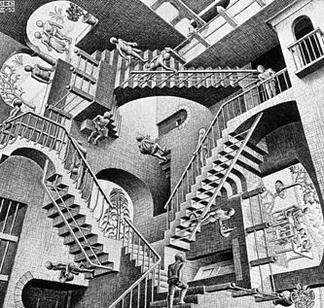
There be metafiction here . . . and it’s kaleidoscopic, with traffic headed in all directions among multiple levels of reality and fiction. Its twists and turns turn back on themselves, like ouroboros, the serpent that bites its own tail, or a Möbius strip, or M.C. Escher’s Relativity, or Escher’s Drawing Hands--because Moore isn’t simply building on Lovecraft, Lovecraft is speaking through him. To seek order in such a labyrinth, you just might catch yourself coming and going--and indeed at one point in Providence, Black does just that:
 
Providence, Issue No. 8
 
Moore’s work isn’t always pleasant--certainly it can be daunting for even the most intrepid of cultural omnivores--but only Moore can be so masterful at bending the reader’s mind. And when he is, he’s either at his best or worst.

Other posts on comics:
Jennifer Blood Feminista
The Batgirl #41 Variant Cover Fracas
The Rise and Fall of Batwoman
Thor Is the Woman of the Day
The Cover of Teen Titans #1

Monday, April 18, 2016

Greek Gods, Parricide and Parenting


Hesiod’s Theogony isn’t very long, but it manages to encompass a hymn to the Muses, an account of the ancient Greek creation myth, a genealogy of dozens of deities, as well as tales of murder, war, love, rape, brute strength and political power. It also shows marvelous insight into human psychology.

In the introduction to the edition I have, translator Dorothea Wender raises an interesting point:
Hesiod has allowed his world of primitive gods and chaotic forces to remain primitive and chaotic. Particularly striking is the general pattern of an oedipal struggle between generations, with father attempting to destroy son, and mother assisting son to supplant father.

One such event is Kronos’s castration of Ouranos with a “long jagged sickle.” Kronos’s mother Gaia asked him to do this because Ouranos was hiding her children so they wouldn’t replace him as ruler. The second such event comes when Kronos begins eating his own children and Rhea secrets away Zeus, who later leads a rebellion.  The war ends with the banishment of the Titans to Tartarus and the ascension of Zeus as ruler of Olympus. Hesiod’s poem is centuries older than Sophocles’ tragedy Oedipus Rex, but already we see the ancients were aware of the Oedipus in every man. To crudely summarize Freud: He wants to sleep with his mother and kill his father.

The Mutilation of Uranus by Saturn, by Giorgio Vasari and Christofano Gherardi

It strikes me that these parricidal myths are less a representation of the actual early childhood situation than they are a reflection of the nascent Subject’s fantasies and fears. In the world we usually take for reality, fathers do not normally kill their children, mothers do not conspire to defeat their husbands, and children know nothing of sex and murder. In the subterranean reality of the child’s psyche, however, nothing is desired more than the mother’s attentions, and nothing presents a greater threat to that than the father.

The young Subject is faced with a dilemma: regain his lost power by defeating and supplanting the father or regain it by allying with and emulating the father. Similar dynamics occur in girls and are sometimes called the Electra complex. How this childhood drama plays out--and the possibilities are endless--has formative effects on the individual that will last throughout life. The ancient Greeks knew nothing of psychoanalysis, but their myths show they were well aware of the human realities that underlie it.

As a father, I have witnessed these realities firsthand. My son loves me and I love him more than either of us will ever fully comprehend, so father-son bonds are not to be discounted, but a rivalry also exists. It is not uncommon for a small boy to want to marry Mommy, and his father is likely to playfully express disapproval of this idea. Many a father feels real jealousy, however, when his wife’s affections appear directed entirely at their child. Boys are thrilled to best (or be allowed to best) Daddy in a game or feat of strength. And at some point, Mommy begins to encourage her child to be more independent so she can return more of her attention to her husband and the rest of her life.

My family demonstrates all of this behavior, and we try to resolve the underlying tensions in positive ways. There are no perfect methods, but spending time together is a great way to allow these human mysteries to work themselves out. If I’d played dominoes with my son this morning, maybe he wouldn’t have rebelled so much when it came time to get him out the door for school!

Over the years psychoanalytic theory and a burgeoning literature on parenting have helped explain and address what goes on inside families, but as usual, the ancient Greeks did all this first. They did it their own way and in some ways, no doubt, they did it better. Theogony is myth not science, but that doesn’t stop it from being enlightening. 

Saturn Devouring His Son, by Francisco Goya


Also on ancient Greek literature:
Heracles' Hope in the Midst of Suffering
The Ancients' Guide to Love and Sex

Saturday, April 16, 2016

The Benefits of Annual Events for Enthusiasts


Today was Record Store Day. For the first time in a few years, I was able to go out and celebrate by visiting a couple record stores. Record Store Day and similar events for enthusiasts, such as Free Comic Book Day (FCBD), are always enjoyable enough for me to look forward to.

The obvious benefit for fangirls and boys is the loot. As FCBD has grown, more publishers have come out with special publications just for the event, which are available for free at comic book stores. Similarly, music labels have special releases on Record Store Day. The local Disk Union had a wall displaying these releases, and many were tempting. I would have loved to walk away with stoner metal group The Sword’s 7-inch “John the Revelator,” but an enthusiast must control expenses, so I opted for only the melodic death metal group Dark Tranquility’s extended edition of their 2007 album Fiction: transparent red vinyl plus a 7-inch disk with extra tracks.

 
A thing of beauty.

But the loot at these types of events often isn’t that great, which is all right because these events are usually created for another purpose: to promote an industry and support local retailers. Small music and comic shops often have trouble attracting enough customers to stay open, but events like Record Store Day and FCBD bring in crowds. Lee’s Comics in San Mateo, California would have at most a handful of people at any given time I visited, but on FCBD, it was hard to get in the door. Sure, your Sheldon Coopers would be there obsessively flipping through the racks, but so would lots of other sorts of people. And Lee’s was great at making the day a family-friendly event, with massive sales and a shopkeeper always ready to direct kids to the children’s comics.

As an enthusiast, I’m happy to show small businesses support. Drops Record wasn’t participating in Record Store Day in any official way today, but I popped in anyway. It’s a new shop in the area that’s trying to attract business. Every time I go, I half expect to find it has disappeared, but so far it has hung in there. I was one of two people looking for records today, and I walked out with a cheap-because-it's-grubby Japanese pressing of the Pink Floyd classic Atom Heart Mother:

 
In addition to the above benefits, it’s simply fun to have an excuse to get out of the house, enjoy yourself, and participate in a subculture. Record Store Day came early for me because I live in Japan, so many places in the world still have the day ahead of them. If you’re into vinyl--or want to be--go hit your local record store. (The Record Store Day website will help you find one.) And if you can’t do that, mark Free Comic Book Day on your calendar. It’s May 7 and good for at least a couple free comics and a good time.


A related post:
Listening to Vinyl: Dust in the Grooves

Wednesday, April 6, 2016

Heracles' Hope in the Midst of Suffering


I don’t know the extent to which the culture of ancient Greece doubted its gods, but Euripides' tragedy Heracles certainly appears to question both their worthiness and existence. And when, in the course of human history, thinkers have entertained the idea that no gods exist, they always find something to replace them.

Heracles opens with the hero away performing his labours (mostly killing stuff) while an upstart ruler has evicted Heracles’ family from their home. Destitute and homeless, they supplicate Zeus for aid even as the ruler plans to execute them. At the last minute, Heracles returns, but the situation only gets worse. Hera sends Iris and Madness to drive Heracles into a frenzy during which he slays his own wife and children. When he returns to himself, he finds he has lost all by his own hands.

This story presents the gods in the worst possible light. The backstory is that Zeus cheated on Hera, sneaking into Megara’s bed and fathering Heracles. Hera exacts her revenge on Heracles and his family, using Iris and Madness as her pawns. We hear not a peep from Zeus despite all the supplication to him. Thus it’s no wonder that the characters repeatedly question the justice of the gods. After the bloodbath, Heracles openly holds the gods in disdain:
Let the glorious wife of Zeus now dance for joy and make Olympus shake with her footsteps! She has achieved her will; she has cast down from on high the foremost man of Greece, toppling him from his very foundations! What man would utter prayers to such a goddess? 
In the face of suffering, Christians claim that everything happens according to God’s will, which is unfathomable to mere mortals, but ever since antiquity, philosophers and common folk alike have seen the existence of evil and suffering as a significant challenge to the existence of any god worth the name. Would a good and all powerful god will the suffering of innocents? (previous post)

That is a riddle all believers face--as Heracles does. My copy of the play has introductory notes by Richard Rutherford, who states the play is merciless in its complete lack of hope for the hero. Instead of the deus ex machina coming at the end of the play to solve all problems, it happens halfway through and only stirs things up. And while some traditions hold that Heracles was later worshipped as payment for his suffering, Euripides has Theseus mention this briefly only to have Heracles shut him down. Nonetheless, I can’t help but disagree with Rutherford, for Euripides does indeed hold out hope.

Only it isn’t divine.

A recurring theme throughout Heracles is friendship. As the new Theban ruler Lycus subjects Heracles’ family to humiliation and worse, no one comes to their aid. The drama isn’t very long, but repeatedly the characters mention how friends tend to disappear in hard times. Amphitryon, Megara’s husband and the man who raised Heracles, states it as follows:
As for friends, some I see are not to be relied upon, while those deserving of the name are powerless to assist. So it is when men encounter misfortune. I pray that no friend of mine, even a mere acquaintance, may have this experience; there is no surer test of friends.

If Epictetus (or what I remember of his writings anyway) is anything to judge by, the vagaries of fate and the evanescent loyalty of friends are commonplace themes in ancient Greek literature, which is exactly why they stood out to me among all the more exciting elements. When you experience hard times, many friends would prefer to keep you and your affliction at an arm’s length, but a few will be there through thick and thin. This is the hope Euripides offers in a world where the gods are dubious entities at best.

This is hard to miss in the text, for not only does it show up repeatedly, but it is the note on which Euripides ends the play. Heracles is a defeated and broken demigod when his old friend Theseus shows up and offers some manly encouragement along the lines of “Quit crying and man up.” To this, Heracles is like, “Come on, everybody hurts sometimes,” and then Theseus, proving himself an understanding friend, is like, “Very well then. You’re welcome to crash at my place.”

They exit.

The caprices of fate strike us all, and when they do, maybe you turn your eyes to the heavens, maybe you don’t, maybe you feel a supernatural power answers, maybe you don’t, but undeniably the existence and qualities of any supposed divinity are uncertain. Friendship, on the other hand, while not always firm, is one hundred percent natural and experienced by all. In the absence of constant gods, we may find solace in inconstant humanity.


Saturday, April 2, 2016

A Brief Train of Thought: Blacks' Magic


One of my favorite album covers is the cover of Salt-N-Pepa’s Blacks’ Magic. I ran across the album last summer and made an impulse buy based on the cover art alone. The other day, I was in the shower thinking about why I like this cover so much, when I had a realization about my attitude toward many issues today.

 
This really is a wonderful cover. Salt, Pepa and Spinderella appear to be having a sleepover in a magnificent library wherein they have discovered a tome of magic. Spellbound, they turn its leaves by candlelight. It’s a cute scene, and a little sexy.

It’s also spooky. Spirits of the dead hang overhead: Nina Simone, Louis Armstrong, Jimi Hendrix and Billie Holiday. Have the girls just chanted a passage summoning these souls from the afterlife? In any case, it’s clear their magic is not black magic of the occult variety but the magic of black musicians.

This is no perfunctory nod to great singers and instrumentalists of the past. No doubt Salt-N-Pepa were inspired by these musicians and hoped to channel a little of their artistry into the hip-hop on Blacks’ Magic. Now take that idea beyond music to all fields from visual arts and literature to science and social reform, and you arrive at an incredibly rich cultural heritage.

At this point in my train of thought, I arrived at Black History Month, which is designed to celebrate exactly this heritage. On social media, the agora of the 21st Century, there is a debate about Black History Month. The dialogue usually plays out with one side promoting the observance, while the other raises objections: If all people are equal, isn’t Black History Month itself racist? Why can’t we have a White History Month? Do we need a History Month for every group imaginable?

I do, of course, take a side in this nitty-gritty free-for-all, but my innermost self, my attitude prior to debate, the part of me that grew up among decent people, simply thinks Black History Month is a nice thing, so why not? The world has plenty of things to celebrate, and why shouldn’t the contributions to cultural heritage by black individuals be among them?

Salt-N-Pepa are interested in black heritage as African Americans, but it strikes me how this heritage is a shared heritage: It’s my heritage, too. Whenever I borrowed my dad’s Woodstock albums as a kid, my favorite tracks were Jimi Hendrix’s “Star Spangled Banner” and “Purple Haze.” The other spirits on the cover of Blacks’ Magic are no strangers either, with Billie Holiday being a particular favorite. Of course, the list doesn’t stop there. In fact, it’s so extensive that listing names would be ridiculous. Whether you feel the need to focus on the racial label or not, black heritage is simply a part of our cultural background, and it has blessed us all.

 
I take this underlying attitude with me to a lot of cultural debates, including but not limited to race issues. The first issues to come to mind are all in popular culture: A black Captain America? Okay, cool! Idris Elba for James Bond? Okay, cool! A Muslim Ms. Marvel? Okay, cool! A lesbian Batwoman? Okay, cool! A gay Star Wars character? Fine by me! A female Thor, who is Thor and even wields Mjolnir? By Valhalla’s gates, yes!

Prior to any debate, I simply approve of a diversity of cool stuff.  

And Blacks’ Magic is cool stuff. Aside from that wonderful cover, it has intelligent lyrics, samples from Public Enemy and James Brown, a bewitching melody borrowed from The Turtles, ubiquitous salt and pepper shaker sounds, hit songs of the nostalgic sort, and a couple songs that even have that perfect hip-hop sound I spent years looking for. “Live and Let Die” is one, but “Swift” is even better:

 
I don’t mean to suggest that there aren’t important issues at stake in the cultural debates of the day, only that it’s also important to step back and simply enjoy what’s out there. This is possible even if you’re the kind of person for whom a progressive social agenda is suspect. There was a time--if only mythic--when we didn’t fight over everything, and if you look, you may find that time exists somewhere within you, too.