Showing posts with label comics. Show all posts

Saturday, April 23, 2016

The Best and Worst of Alan Moore’s Providence (So Far)


Providence is the latest series by Alan Moore, the mad genius of comics. It’s about a journalist named Robert Black who encounters people and places from H.P. Lovecraft’s Cthulhu Mythos. Providence is dark, literary and disturbing, and it demonstrates the best and worst of Moore’s talents.

 
The Worst (Issue No. 6)

The series has plenty of freaky moments, but the first Moore-moment, the type of moment that makes you wonder if you should stop reading before it’s too late, comes when Black visits a college town and runs into a student named Elspeth. She invites him in from the rain and then proceeds to strip naked. Black then finds that his consciousness has been transferred into Elspeth’s body and somebody else’s consciousness has taken control of his own body. Under a stranger’s control, Black’s body then rapes Elspeth’s body, which has his own consciousness inside. Afterward, Black feels guilty, confused and violated--which is how I imagine many readers feel after having read that scene.

Thanks to the website Facts in the Case of Alan Moore’s Providence, I learned this scene channels Lovecraft’s story “The Thing on the Doorstep” (1937). I’ve since read the story, and it’s full of the madness that was Lovecraft’s specialty. It tells the story of Edward Derby, whose wife Asenath Waite projects her consciousness into him, taking control of his body and trapping him in hers. There are creepy in-laws, dangerous tomes, gateways to other worlds, fishy smells and . . . shoggoths. Even worse, Asenath isn’t entirely human, because she’s one of the Innsmouth Waites, which are known to have had congress with strange beings.

“The Thing on the Doorstep” shows that Alan Moore isn’t pulling everything out of his own imagination. H.P. Lovecraft has been there first.
 

Of course, when I say the rape scene in Providence is the worst of Alan Moore, I mean the subject matter is extremely disturbing. It reminds me of the freakiest scenes in Moore’s other titles, like Jack the Ripper’s grisly work on Mary Kelly in From Hell and the interdimensional subterranean orgy in Neonomicon. The latter graphic novel found its way into libraries and then back out again over complaints. Some would say Moore goes too far, but considering this is horror, the sheer awfulness of his work shows he is getting something right.

 
The Best (Issue No. 8)

Unstuck consciousnesses also feature in Providence’s best. When Black meets an author named Carver to discuss dreams, the panels alternate between showing the two seated at a table and showing the personal experiences, historical anecdotes, dreams and paranormal encounters they are discussing. In the latter scenes, the speech balloons for Black and Carver continue in the mouths of people in their subject matter:


The issue continues to play around with this, until by the end, a font change suggests people in the real world are speaking lines from fiction. These are people in the real world of the comic, so who could be putting words in their mouths? According to Facts in the Case of Alan Moore’s Providence, the lines are from Lovecraft’s story “Beyond of Wall of Sleep” (1919), so the words are Lovecraft’s. By this point, however, the reader can’t help but be aware of the spirit of Alan Moore himself haunting, and manipulating, the series.

And it only gets more convoluted.  Providence is itself a work of fiction based on fiction by H.P. Lovecraft, and Lovecraft himself shows up in the issue. Thus, the real author of fiction called the Cthulhu Mythos shows up as a fictional character in a work of the Cthulhu Mythos, a work in which his own fictional creations are real. Does this fictional Lovecraft write fiction or does he pass off as fiction descriptions of the horrifying reality Black has been encountering? Once Moore sinks his claws in your brain, it almost feels plausible that the real Lovecraft--like the painter in “Pickman’s Model” (1927) and his analog the photographer Pitman in Providence--may have done the same!

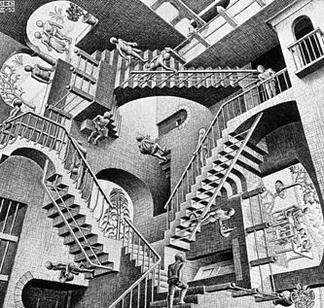
There be metafiction here . . . and it’s kaleidoscopic, with traffic headed in all directions among multiple levels of reality and fiction. Its twists and turns turn back on themselves, like ouroboros, the serpent that bites its own tail, or a Möbius strip, or M.C. Escher’s Relativity, or Escher’s Drawing Hands--because Moore isn’t simply building on Lovecraft, Lovecraft is speaking through him. To seek order in such a labyrinth, you just might catch yourself coming and going--and indeed at one point in Providence, Black does just that:
 
Providence, Issue No. 8
 
Moore’s work isn’t always pleasant--certainly it can be daunting for even the most intrepid of cultural omnivores--but only Moore can be so masterful at bending the reader’s mind. And when he is, he’s either at his best or worst.

Other posts on comics:
Jennifer Blood Feminista
The Batgirl #41 Variant Cover Fracas
The Rise and Fall of Batwoman
Thor Is the Woman of the Day
The Cover of Teen Titans #1

Saturday, April 2, 2016

A Brief Train of Thought: Blacks' Magic


One of my favorite album covers is the cover of Salt-N-Pepa’s Blacks’ Magic. I ran across the album last summer and made an impulse buy based on the cover art alone. The other day, I was in the shower thinking about why I like this cover so much, when I had a realization about my attitude toward many issues today.

 
This really is a wonderful cover. Salt, Pepa and Spinderella appear to be having a sleepover in a magnificent library wherein they have discovered a tome of magic. Spellbound, they turn its leaves by candlelight. It’s a cute scene, and a little sexy.

It’s also spooky. Spirits of the dead hang overhead: Nina Simone, Louis Armstrong, Jimi Hendrix and Billie Holiday. Have the girls just chanted a passage summoning these souls from the afterlife? In any case, it’s clear their magic is not black magic of the occult variety but the magic of black musicians.

This is no perfunctory nod to great singers and instrumentalists of the past. No doubt Salt-N-Pepa were inspired by these musicians and hoped to channel a little of their artistry into the hip-hop on Blacks’ Magic. Now take that idea beyond music to all fields from visual arts and literature to science and social reform, and you arrive at an incredibly rich cultural heritage.

At this point in my train of thought, I arrived at Black History Month, which is designed to celebrate exactly this heritage. On social media, the agora of the 21st Century, there is a debate about Black History Month. The dialogue usually plays out with one side promoting the observance, while the other raises objections: If all people are equal, isn’t Black History Month itself racist? Why can’t we have a White History Month? Do we need a History Month for every group imaginable?

I do, of course, take a side in this nitty-gritty free-for-all, but my innermost self, my attitude prior to debate, the part of me that grew up among decent people, simply thinks Black History Month is a nice thing, so why not? The world has plenty of things to celebrate, and why shouldn’t the contributions to cultural heritage by black individuals be among them?

Salt-N-Pepa are interested in black heritage as African Americans, but it strikes me how this heritage is a shared heritage: It’s my heritage, too. Whenever I borrowed my dad’s Woodstock albums as a kid, my favorite tracks were Jimi Hendrix’s “Star Spangled Banner” and “Purple Haze.” The other spirits on the cover of Blacks’ Magic are no strangers either, with Billie Holiday being a particular favorite. Of course, the list doesn’t stop there. In fact, it’s so extensive that listing names would be ridiculous. Whether you feel the need to focus on the racial label or not, black heritage is simply a part of our cultural background, and it has blessed us all.

 
I take this underlying attitude with me to a lot of cultural debates, including but not limited to race issues. The first issues to come to mind are all in popular culture: A black Captain America? Okay, cool! Idris Elba for James Bond? Okay, cool! A Muslim Ms. Marvel? Okay, cool! A lesbian Batwoman? Okay, cool! A gay Star Wars character? Fine by me! A female Thor, who is Thor and even wields Mjolnir? By Valhalla’s gates, yes!

Prior to any debate, I simply approve of a diversity of cool stuff.  

And Blacks’ Magic is cool stuff. Aside from that wonderful cover, it has intelligent lyrics, samples from Public Enemy and James Brown, a bewitching melody borrowed from The Turtles, ubiquitous salt and pepper shaker sounds, hit songs of the nostalgic sort, and a couple songs that even have that perfect hip-hop sound I spent years looking for. “Live and Let Die” is one, but “Swift” is even better:

 
I don’t mean to suggest that there aren’t important issues at stake in the cultural debates of the day, only that it’s also important to step back and simply enjoy what’s out there. This is possible even if you’re the kind of person for whom a progressive social agenda is suspect. There was a time--if only mythic--when we didn’t fight over everything, and if you look, you may find that time exists somewhere within you, too.

Thursday, December 31, 2015

Adventures of a Cultural Omnivore: 2015


Each December, I try to put up a post on the best media I encountered throughout the year. This year, my omnivorous appetite for culture concentrated on music more than anything, but I did all right in other categories as well.

 
Books

I didn’t neglect fantasy (George R.R. Martin's A Song of Ice and Fire) or science fiction (Warhammer 40K), but as usual, the classics made the biggest impression. Joseph Conrad’s portrayal of the British Empire in Heart of Darkness connected in my mind with W.E.B. Du Bois’s comments on colonialism and racism in “The Souls of White Folk,” and I almost got around to a whole series of posts on it (previous post). Honorable mentions would include Franz Kafka’s The Trial, for its absurdist take on the workings of bureaucracy, and Hemingway’s Men Without Women. Every time I read Hemingway, I wonder why, if he had such an impact on English style, more authors don’t write like he did.

 
Comics

I would recommend He-Man and the Masters of the Universe from DC Comics to anyone who enjoys fantasy, and I would highly recommend Neil Gaiman and Mark Buckingham’s run on Miracleman from the Nineties, now being brought to digital format by Marvel. However, nothing could top Ms. Marvel this year.

Kamala Khan is a Pakistani-American high school girl and a Muslim. After a weird gas gives her the ability to stretch her body, she starts fighting Jersey City’s bad guys and, completely without permission, adopts the name Ms. Marvel, which once belonged to her idol Carol Danvers, currently known as Captain Marvel. For her costume, she redesigns a burkini.
 
 
Kamala gained a lot of press as DC’s first Muslim character with her own title, and her cultural and ethnic background is important, but she’s also just a high school girl running the teenage gauntlet and trying to figure out who she wants to be--and it isn’t anybody but herself. She doesn’t have her parents’ roots in Pakistani culture, she isn’t as religious as her brother, and she isn’t like the other kids at her typical American school either. She has squabbles with peers and falls in and out of love and is painfully self-conscious and unsure of herself.

Literature is full of cookie-cutter caricatures along those lines, but writer G. Willow Wilson brings Kamala to life in ways that resonate across cultural and generational divides, and Adrian Alphona’s art is unique, effective, and frequently hilarious. Together, the two serve up everything from typical superhero exploits to tear-jerking drama--and at least one moment among the most powerful I’ve ever read.

Early in Volume 1, Kamala’s powers are fluctuating wildly and she suddenly finds she has transformed to look exactly like her hero Captain Marvel, a classic buxom blond beauty whom Kamala sees as perfect. But a mere 23 pages into the series, I had already come to understand and care about Kamala so strongly that I only wanted her to be who she is--a short, sometimes clumsy brown-skinned girl with unruly black hair. That’s part of her beauty, and watching her turn white felt wrong, wrong, wrong.
 
 
I was so impressed by Kamala Khan, and have been so unimpressed with most of the 2016 presidential candidates, that I even whipped up a couple memes featuring her. Nothing mind-blowing, but feel free to share:

 
I love it when she embiggens her fists:


Movies

Early in the year, I continued a stretch of films from director Jean-Luc Godard. Then after my son started leaving the house each day for kindergarten, I was actually able to hit the movie theater every now and then! Spectre and Star Wars: The Force Awakens were both excellent, but it was Mad Max: Fury Road that inspired me most. The result was a series of blog posts examining the movie from the perspectives of feminism, Christian myth, and Marxism:

     Jennifer Blood Feminista
     Mad Max: Of Hawks and Doves
     Mad Max: Out of Eden
     Mad Marx: Frederick Road
 

Television

I also found the time--I have no idea how--to watch more TV this year. Penny Dreadful and Outlander were entertaining, while Supergirl was just the fluff I was looking for. The show has problems, but Melissa Benoist isn’t one of them. She’s fairly wonderful, and watching her deal with her life as Kara Danvers is one of the highlights of the series. Meanwhile, Game of Thrones continues to engross and Syfy appears to have a quality space opera in The Expanse. However, Mad Men really was the best show on television, and the question needs to be asked: Has there ever been a better show on television?

 
Video Games

The only video game I played this year, aside from a little Relic Run (Tomb Raider) on my iPhone, was Silent Hill: Downpour. I felt like it was a return to form for home console games in the series, after Homecoming was so bad GameStop salespersons encouraged me not to buy it. I should have listened. Downpour doesn’t try to break or even bend the template for Silent Hill, it just tries to get it right and succeeds.

 
Music

This year, I learned that scores of bands I’ve never heard of are pumping out some incredible metal: Barren Earth, Khemmis, My Dying Bride, Tribulation, Krisiun, Avatarium, Sylosis, Sulphur Aeon. However, the bands that really struck a chord with me this year lay in a completely different direction. One was Siouxsie and the Banshees. I can’t believe I didn’t discover them earlier. They belong in the company of alternative music greats like U2, R.E.M. and The Cure, and you may put “Night Shift” on my list of coolest songs ever:

 
Then one morning I put on some Jefferson Airplane and Grace Slick’s voice in “Somebody to Love” electrified me. Of course I’d heard the song countless times, but this time I really heard it. Now Jefferson Airplane is an obsession. I’m still just wading in, but the water promises to get deep as I explore more of their music and the movement out of San Francisco that they were a part of:

 
And there you have my favorites from 2015. Let me know yours. This cultural omnivore is always looking for something else to eat.

 
Related posts:
Twilight of the Cultural Omnivores
Best in Comics 2014
Best in Music 2014
Best of Books 2014
Best in Movies, Video Games, Comics 2013
Best in Music 2013
Best in Books 2013

Monday, December 22, 2014

The Best of 2014: Comics


This is a category that usually gets scant treatment in my Best Of posts, but 2014 was a good year in comics. Largely, this is due to a friend turning me on to digital comics. I quickly got caught up with Batwoman (previous post), and began looking around for the best titles today--among them Neil Gaiman’s return to The Sandman, Gerard Way’s contribution to the Spider-Verse, and the best-selling reboot of Ms. Marvel.

But what grabbed me most this year was a manga series called Cherry from a lesser-known author named Eisaku Kubonouchi. Volumes of Cherry have decidedly girly covers, so I was embarrassed when purchasing my first volume, but the story dragged me in, so I had to go back for more.


Cherry is a romantic comedy about recent high school graduate Kaoru, who works at a convenient store in a rural community. Sick of his dull life and unsure about the future, he elopes to Tokyo with his childhood sweetheart Fuko, but no sooner do they arrive than they realize they have no money, no jobs and no place to stay. Sure, the plot setup is half-baked, but so are Kaoru and Fuko. As they learn to fend for themselves in the city, they learn about love, friendship and growing up.

I was first attracted to Kubonouchi’s work when I ran across his sketches on Twitter. His illustrations of young women are dazzling and capture the essence of the Japanese word kirei (綺麗). Kirei means “pretty,” but it carries a number of other connotations. Foremost among them is cleanliness, but kirei also suggests delicacy and elegance more strongly than its English counterpart. Kirei is everything Japanese culture has traditionally told girls they should be. We might complain about the negative effects of such norms, but girly girls are people too and Kubonouchi draws them stunningly.

The above front covers are decent examples of Kubonouchi’s sense of kirei, but I recommend checking out his Twitter feed. He regularly posts illustrations at various stages of development from rough sketch to full color, and many showcase his humorous and cartoonish side as well.


Toward the end of the series, the complications of adult life--money, jobs, time constraints, social ties--threaten to pull Kaoru and Fuko apart, but they realize all the hard work and stress isn’t worth anything if you lose the one you love. This is cliché, but isn’t it something we all struggle with? How often do we feel like all the stuff that is dominating our lives isn’t what’s really important?

For all that, Cherry is also comedy. Kaoru and Fuko elope riding a pig, make friends with quirky characters, tangle with yakuza stooges, and get into the most ridiculous situations. Kubonouchi keeps the laughs coming, and the humor combined with striking art and a touching love story made this manga the most enjoyable comic series I read this year.


Saturday, October 18, 2014

The Rise and Fall of Kate Kane aka Batwoman


“Kate Kane survived a brutal kidnapping by terrorists that left her mother dead and her twin sister lost. Following in her father’s footsteps, she vowed to serve her country and attended West Point until she was expelled under ‘Don’t Ask, Don’t Tell.’ Now she is many things: estranged daughter, grieving sister, proud lesbian, brave soldier, determined hero. She is Batwoman.” --Batwoman 


Successful superheroes inspire their corporate backers to create spinoffs. Thus, Superman gets a whole family complete with pet dog Krypto, while Batman has Batgirl and the lesser-known Batwoman (profile). This kind of gimmick may sound corny to those who don’t read comics, but when DC Comics rebooted Batwoman in 2006, they weren’t messing around.

One thing to know about Batwoman is she is a lesbian. As I remember it, her new incarnation’s very first appearances were unremarkable, but her sexual orientation raised eyebrows among comic book readers. I remember gay men appearing in comics before, but I don’t remember any lesbians. This was when I first heard the term “lipstick lesbian,” because Kate Kane--the woman behind the mask--exhibits traditionally feminine traits such as wearing makeup.

At first, it seemed DC intended to relegate this bold move to a practically unknown character, but that proved untrue. From 2009 to 2010, Batwoman was the main feature in issues #854-#863 of Detective Comics, one of DC’s longest-running titles and the one that introduced Batman in 1939. The creative team was top-notch, consisting of writer Greg Rucka and artist J.H. Williams III. They developed what was to become, for a time, one of DC’s better characters.

Rucka/Williams--and later Williams and W. Haden Blackman--handled Batwoman’s sexual orientation with skill. It was no joke or cheap thrill, and while an egalitarian message did appear from time to time, it was never ham-fisted. Instead, the series simply showed what it would be like for a woman who happens to be gay to also be a superhero.

For years in comics and film, we have seen Bruce Wayne try to balance his life as a crimefighter with his love life, and Kate Kane must do the same. Her main love interest is Maggie Sawyer, who gets jealous when vigilantism or other women take too much of her girlfriend’s time. There’s kissing, cuddling and lazing in bed, but it’s never voyeuristic. And while there are plenty of hotties hanging around--a busty blond here, an exotic femme fatale there--Kate is no playgirl. The relationships come across as more meaningful than the customary Bruce Wayne fling.


What intrigued me most was how the creative minds behind Batwoman balanced a socially conscious hero with the traditional eye-candy approach of comics. In regular life, Kate Kane is a petite and cute redhead with a wardrobe that blends Goth, girly and menswear à la Coco Chanel. But as Batwoman, she’s a busty, leggy wonder in skintight black latex with red highlights.
 
 
However, the approach was always respectful. Often when comics decide to focus on women, the result is a gaggle of bodacious superheroines lounging around like Victoria’s Secret Angels before launching into battles that require flouncing in ways that plant their special parts right in your face. By contrast, Batwoman always manages to look good, and there’s a healthy eroticism at work, but she’s never there for drooling over.

Feminism has taken a liking to comics, and Batwoman satisfies its demands well without preaching. Rereading early arcs of Batwoman’s own monthly title, I was surprised at the degree to which powerful and professional women dominate the cast of characters. Kate’s girlfriend Maggie is a captain in the Gotham City Police Department, she maintains a rocky working relationship with Agent Cameron Chase of the Department of Extranormal Operations, and her sidekick is Bette Kane (aka Flamebird). The villains tend to be women as well, from her twin sister Beth to the Medusa operative Sune. Aside from Kate’s father, who serves as Kate’s primary backup, men come and go and generally carry little weight.

In addition to addressing timely issues, Batwoman was for years simply written and drawn better than most comics. The writing maintained the carnivalesque atmosphere of Batman and combined it with a gritty, noir realism. Meanwhile, the art was stunning.

But comic book publishers excel at ruining a good thing.

In 2013, Williams and Blackman suddenly quit because of editorial interference. Apparently it had been going on for a while, and when DC told them Kate Kane and Maggie Sawyer could not get married, it was the last straw. They were on board to do a few more issues, but DC cut them off just as Batwoman was about to kick Batman’s betighted ass.


New month, new creative team, new arc (without any resolution to the previous one), and a massive drop in quality. Batwoman has since become a vampire and fought a battle in outer space against monsters so unimaginative that Ben 10: Alien Force, or hell, the Care Bears would sniff in derision. I hate to end on a sour note, but I shouldn’t have kept my subscription as long as I did. Creative teams like those who oversaw Batwoman’s rebirth rarely come along, and now they’ve moved on to other projects.


Monday, July 7, 2014

Two Narratives, Both Alike In Dignity--The Cover of Teen Titans #1


Something that keeps getting forgotten in the culture wars is how one and the same work, and even individual signs within a work, can be interpreted in exactly opposite ways.

Former DC Comics editor Janelle Asselin tore into the cover of Teen Titans #1 in a recent post on Comic Book Resources. She criticizes cover artist Kenneth Rocafort’s grasp of anatomy, perspective, design, and even signature placement. She also criticizes publisher DC Comics for not understanding the Teen Titan fanbase and potential markets. Along the way, a great deal of text is dedicated to what she considers the cover’s poor social sensibilities. Why does the teenage Wonder Girl have breasts the size of her head and the shape of implants? Why is she wearing a top that she’s going to fall out of the first time a supervillain sneezes? Why is Bunker, who is Mexican, so far in the background?

As is only to be expected, some people did not agree and spoke out. Those people included Teen Titans interior artist Brett Booth (tweets here), comic book fans who felt Asselin’s critique was overwrought, and men who express disagreement through rape threats. Also as only to be expected, a vigorous defense was mounted on Asselin’s behalf (an example).

Many of Asselin’s points are fine enough with me, but let’s look at the cover again. Why doesn’t she praise Rocafort for putting a female Teen Titan in the center, a position that indicates leadership and commands attention? Why doesn’t she compliment the fact that the Teen Titans have a person of color in their group at all? Bunker is indeed in the back, but he’s also hovering above everyone and noticeable at a glance. Why charge DC with being resistant to targeting diverse audiences, when only one of the five pictured Teen Titans is a white male (two if you count Beast Boy who is now green)?

Asselin does mention some of the aspects of the cover I have just highlighted, but she does not say anything positive about them. They merely come up in passing as part of a stream of insults. Why choose to put this particular spin on the cover? Because one narrative has been chosen at the exclusion of another.
 
A few more examples of opposing narratives:
 
If Jared Leto plays a trans woman and wins accolades (Dallas Buyers Club), does this show Hollywood’s willingness to embrace alternate lifestyles? Or because Leto himself isn’t transgender, does it show that trans people are still marginalized?

If Avril Lavigne uses Japanese backup dancers in a music video shot in Japan (“Hello Kitty”), is she using her dancers as props in an act of cultural appropriation? Or is she showing respect for her fans in Japan?

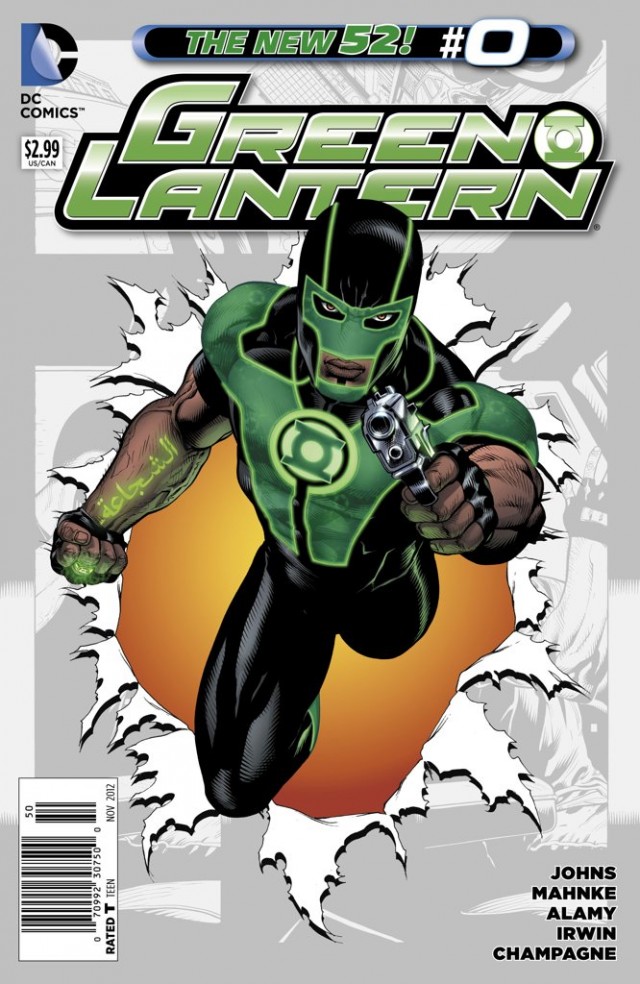
If DC Comics introduces a Muslim Green Lantern, is this mere tokenism? Or is this a move to include a minority in a medium traditionally geared toward white men?


What determines which narrative one chooses?

Narratives stitch together certain facts at the exclusion of others, projecting a version of the truth that is incomplete. Some narratives will be better grounded in fact than others, some more rigorous in their logic, and some offered in better faith. Some will be really bad: erroneous, ill-reasoned and deceptive. But here we have cases in which both narratives make reasonable claims based on a shared work of art.

Is it not possible to grapple with all the narratives? To negotiate them? To navigate them? If those prone to one-sided harangues have done so, they do not act like it. They do not write like it. Instead, they give every sign of a predisposition choosing, driving, their narrative. The same lack of critical thought is occurring throughout public discourse on nearly every issue. Everyone begins with a narrative. They’re just looking for a new excuse, a new stimulus, to begin laying it down.

What keeps amazing me is that the people who should know better, the educated bloggers and other critics who speak the language of postmodernism, are little better than their worst opponents at this level. They know better in theory, but their behavior, their tone, is that of the self-righteous who are certain they possess The Truth. One would think the only thing they learned from intersubjectivity is that their subjectivity is right.

Which is to say they haven’t really learned anything at all.

Asselin presents a compelling narrative--a selective take on a Teen Titans cover--but other narratives no less compelling or grounded in the same material are possible. The same plurality of responsible interpretations is available in many of the issues of our day. Surely most of us can recognize that and stitch together multiple threads into a broader tapestry?


Sunday, December 22, 2013

My Personal Best of 2013 in All the Rest: Movies, TV, Video Games and Comics

I may have managed to read a fair amount of books (blog) and listen to a lot of music (blog) in 2013, but I had little time for other types of media. Nonetheless, I always make an effort, so here’s my best of 2013 in movies, television, video games and comics.

The only movie I saw in movie theaters this year, and the most enjoyable movie I saw this year, was Star Trek: Into Darkness. J. J. Abrams’s reboot of Star Trek is the best thing to happen to the franchise since Star Trek: The Next Generation. But the rest of my movie viewing tended to be of classics, which I find increasingly reliable for stimulation (blog). After hearing philosopher Slavoj Zizek discuss Possessed (1931) in the following clip from The Pervert’s Guide to Cinema, I had to check it out. (Discussion of Possessed starts after the intro and finishes at 3:16 when he starts talking about The Matrix.)


In Possessed, a short and fast-paced film, Joan Crawford plays a factory worker who becomes the kept woman of a city gent (Clark Gable). At first, she’s just out for his money, and even tells him so, but she ends up falling in love and desiring marriage even though the ensuing scandal would harm his chances of being elected governor. It doesn’t sound like anything special, but like all great films, it covers a lot of ground, as the back cover of the DVD summarizes so well:

“This pre-Code scorcher…expertly mixes greed, ambition, politics and sex into a frank portrait of a world where men have power and women have a sell-by date stamped on their flesh.”


I fared less well in television this year, falling even further behind with series I love like Game of Thrones and Mad Men. These are on hold until my wife and I can find time to sit down together and watch them--which means the situation is dire. On my own, I did find time to watch both seasons of Rome. The shifting fortunes of soldiers Titus Pullo and Lucius Vorenus were entertaining, and it was interesting to watch the fall of the Roman Republic as the House of Caesar rose, but I enjoyed most the character of Atia of the Julii. She schemes for her family’s power with such lovable simplicity that the sore price she pays in the end, as her son finally rises to become Emperor Augustus, makes her tragic. Here is Polly Walker in full flurry as Atia the Amoral:


In video games, I played through The 3rd Birthday, a sci-fi shooter and spin-off from the Parasite Eve series, on my trusty PSP, and, in a sudden burst of activity, I busted out the old PS2, scraped the crust out of its crevices, and finished off Silent Hill 2--a game I began seven years ago way back in 2006. I got the suicide ending, which apparently means I play on the edge with no regard for danger. I would have expected to get the chickenshit ending, but this is much cooler.

Comics suffered the worst this year since I have yet to find an economical and convenient way to buy them in Japan. However, I did read through the graphic novel of the Spider-Man classic Kraven’s Last Hunt, and it proved to be as engrossing as it was when I was a kid scouring the shelves for single issues at Day & Palin in Farmington, IL. When Kraven the Hunter decides it’s time to kill Spider-Man and take his place, we readers get a deep look into the psyches of the two, their darkness and strength.


All in all, as 2013, the Year of Dwindling Free Time, draws to a close, I count myself blessed. I can never read enough or absorb enough music, but increasingly I find that other forms of entertainment like movies, TV and video games can take a backseat to everything else. Much better to spend time with my family, say by talking with my wife over a bottle of Sangria or using Tomica cars to knock down Transformers with my son.