Showing posts with label Alan Moore. Show all posts

Saturday, April 23, 2016

The Best and Worst of Alan Moore’s Providence (So Far)


Providence is the latest series by Alan Moore, the mad genius of comics. It’s about a journalist named Robert Black who encounters people and places from H.P. Lovecraft’s Cthulhu Mythos. Providence is dark, literary and disturbing, and it demonstrates the best and worst of Moore’s talents.

 
The Worst (Issue No. 6)

The series has plenty of freaky moments, but the first Moore-moment, the type of moment that makes you wonder if you should stop reading before it’s too late, comes when Black visits a college town and runs into a student named Elspeth. She invites him in from the rain and then proceeds to strip naked. Black then finds that his consciousness has been transferred into Elspeth’s body and somebody else’s consciousness has taken control of his own body. Under a stranger’s control, Black’s body then rapes Elspeth’s body, which has his own consciousness inside. Afterward, Black feels guilty, confused and violated--which is how I imagine many readers feel after having read that scene.

Thanks to the website Facts in the Case of Alan Moore’s Providence, I learned this scene channels Lovecraft’s story “The Thing on the Doorstep” (1937). I’ve since read the story, and it’s full of the madness that was Lovecraft’s specialty. It tells the story of Edward Derby, whose wife Asenath Waite projects her consciousness into him, taking control of his body and trapping him in hers. There are creepy in-laws, dangerous tomes, gateways to other worlds, fishy smells and . . . shoggoths. Even worse, Asenath isn’t entirely human, because she’s one of the Innsmouth Waites, which are known to have had congress with strange beings.

“The Thing on the Doorstep” shows that Alan Moore isn’t pulling everything out of his own imagination. H.P. Lovecraft has been there first.
 

Of course, when I say the rape scene in Providence is the worst of Alan Moore, I mean the subject matter is extremely disturbing. It reminds me of the freakiest scenes in Moore’s other titles, like Jack the Ripper’s grisly work on Mary Kelly in From Hell and the interdimensional subterranean orgy in Neonomicon. The latter graphic novel found its way into libraries and then back out again over complaints. Some would say Moore goes too far, but considering this is horror, the sheer awfulness of his work shows he is getting something right.

 
The Best (Issue No. 8)

Unstuck consciousnesses also feature in Providence’s best. When Black meets an author named Carver to discuss dreams, the panels alternate between showing the two seated at a table and showing the personal experiences, historical anecdotes, dreams and paranormal encounters they are discussing. In the latter scenes, the speech balloons for Black and Carver continue in the mouths of people in their subject matter:


The issue continues to play around with this, until by the end, a font change suggests people in the real world are speaking lines from fiction. These are people in the real world of the comic, so who could be putting words in their mouths? According to Facts in the Case of Alan Moore’s Providence, the lines are from Lovecraft’s story “Beyond of Wall of Sleep” (1919), so the words are Lovecraft’s. By this point, however, the reader can’t help but be aware of the spirit of Alan Moore himself haunting, and manipulating, the series.

And it only gets more convoluted.  Providence is itself a work of fiction based on fiction by H.P. Lovecraft, and Lovecraft himself shows up in the issue. Thus, the real author of fiction called the Cthulhu Mythos shows up as a fictional character in a work of the Cthulhu Mythos, a work in which his own fictional creations are real. Does this fictional Lovecraft write fiction or does he pass off as fiction descriptions of the horrifying reality Black has been encountering? Once Moore sinks his claws in your brain, it almost feels plausible that the real Lovecraft--like the painter in “Pickman’s Model” (1927) and his analog the photographer Pitman in Providence--may have done the same!

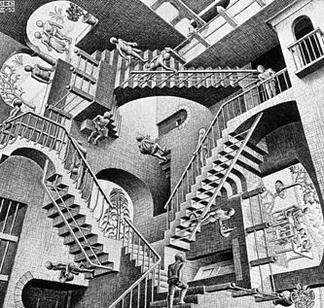
There be metafiction here . . . and it’s kaleidoscopic, with traffic headed in all directions among multiple levels of reality and fiction. Its twists and turns turn back on themselves, like ouroboros, the serpent that bites its own tail, or a Möbius strip, or M.C. Escher’s Relativity, or Escher’s Drawing Hands--because Moore isn’t simply building on Lovecraft, Lovecraft is speaking through him. To seek order in such a labyrinth, you just might catch yourself coming and going--and indeed at one point in Providence, Black does just that:
 
Providence, Issue No. 8
 
Moore’s work isn’t always pleasant--certainly it can be daunting for even the most intrepid of cultural omnivores--but only Moore can be so masterful at bending the reader’s mind. And when he is, he’s either at his best or worst.

Other posts on comics:
Jennifer Blood Feminista
The Batgirl #41 Variant Cover Fracas
The Rise and Fall of Batwoman
Thor Is the Woman of the Day
The Cover of Teen Titans #1

Friday, March 20, 2015

Nihilism and the Batgirl #41 Variant Cover Fracas


"I remember you describing the white face and the green hair to me when I was a kid. Scared the hell out of me."  --Barbara Gordon


I’m thankful to live in a time when comic books are taken seriously enough to occasion regular scandals discussed not just among fans but also in mainstream publications. One such controversy arose this week when DC Comics revealed a variant cover for Batgirl #41 illustrated by Rafael Albuquerque:

 
At first glance, it's nothing more than your standard cover depicting a supervillain threatening a superhero. The Joker, one of the comic book genre’s most homicidally maniacal villains, has done this countless times, and putting his mad grin on his victims in one way or another (laughing gas, paint, blood) has been a constant motif since the character’s appearance in 1940. Nonetheless, there was an immediate furor and accompanying hashtag campaign to #ChangeTheCover.

Those calling on DC to change the cover said it's too dark for the New 52 imprint's incarnation of Batgirl, which has featured cartoonish art and brighter themes. The current run of Batgirl has also attempted to portray female heroes in an empowering light--and indeed this is the trend in mainstream comics today--and yet Albuquerque’s cover depicts Batgirl as a victim, quivering and in tears. Even worse, the cover is yet another example of that old trope in male-dominated media of men threatening women, which all too often carries a suggestion of the female character’s sexual vulnerability and tantalizes readers with the possibility of vicarious rape. It doesn’t help that the cover is an allusion to the acclaimed yet notorious Batman graphic novel The Killing Joke (1988) written by Alan Moore, in which the Joker shot Barbara Gordon (one of the women to have worn the cowl), stripped her naked, photographed her bleeding and nude, and also may have raped her.

The cover has had its defenders. The Joker is a fictional villain, so of course he isn’t going to conform to enlightened standards of morality. Besides, it’s just a variant cover and it refers to canonical events in Barbara Gordon’s past. Caving in to outcry from some people according to their taste sets a dangerous precedent allowing future social justice warriors to prevent bad guys from doing bad things and, even worse, artists from doing their job with integrity. Is it not a form of censorship to tell artists that they may not draw anything some people find offensive? As Green Arrow artist Patrick Zircher Tweeted, by those standards The Killing Joke, a masterpiece of the genre, would not stand a chance of publication today. Comic book writers, artists and publishers could soon find themselves conforming to standards more suffocating than when every comic came stamped with the approval of the Comics Code Authority.

Personally, I think the cover is good precisely because of its questionable taste. It’s about time someone made the Joker disturbing again. Perhaps more than any other villain, he should be disturbing. This is what made The Killing Joke great. It didn’t treat the Joker as a goofy character in a book, it treated him like the embodiment of something you should fear like the Devil. Barbara Gordon herself impresses this upon Batman in the graphic novel:
No! No, it’s not okay! He’s . . . He’s taking it to the limit this time . . . You didn’t see. You didn't see his eyes.

But that’s just my take and I don’t like takes as much as I like getting to the bottom of things. So which side has the argument that settles the issue and how do we know? Which is the argument that it all boils down to? As usual with these debates, which rest on conflicting interpretations of an inherently ambiguous text, I hold there is no right answer and nowhere to turn for the final word on the matter as a whole.

From Batgirl #40 illustrated by current series regular Babs Tarr:

 
It would be gratifying if there were a right answer, then we could be certain we had it and everyone else was wrong. And it would be easier, because then there would be proof, some logic, some evidence, some authority that would end the debate. But there isn’t. Even something like artistic integrity that would seem paramount only extends as far as the artist’s right to draw what he wants and doesn’t extend any further. Most would agree, for example, that DC can publish whatever it wants, critics can raise a fuss if they want, consumers can buy or not buy the issue as they please, and so on.

Without any clear answer, our only recourse for resolving such an issue is a messy process involving a multitude of individuals, organizations, systems and cultural milieux hashing it out, sometimes duking it out, or simply shouting it out, to one imperfect conclusion or another. In this case, while many have grumbled at the outcome, when the SJWs raised a fuss, the artist apologized and the company agreed not to publish the cover. That wasn’t the right answer in any absolute sense--there is no such answer--but it was the answer that arose out of the cacophony of voices, rights and interests involved.

And it isn’t half-bad.

This type of thought is sometimes called anti-foundationalism, for it denies the existence of any ultimate ground upon which opinion about what should be rests. It is part of the positive brand of nihilism championed by politician and philosopher Gianni Vattimo. I’ve blogged about it before with regard to Thomas Piketty’s Capital in the Twenty-First Century, and it has changed the way I approach nearly every issue. In a world without Truth, people must communicate--speaking and listening--to reach a consensus.

Consider this from Vattimo’s Nihilism & Emancipation:
An ethics that no longer refers to the Other, meaning to a transcendent being, will be an ethics of negotiation and consensus rather than an ethics of immutable principles or categorical imperatives speaking through the reason of everyone.

And this:
The goal is not to establish a definitive proof once and for all, only to establish an agreement that, albeit subject to revision, does nevertheless seriously bind the contracting parties (much more seriously than any “eternal principle” whatsoever.)

In the case of Batgirl #41, we might say that a weak consensus--or an apparent majority opinion--was reached by those whose interests were most immediately at stake, those who made their voices felt most firmly, and the general trend toward social consciousness in media. This consensus is flawed, temporary, and not without detractors, detractors who are at liberty to rejoin the fight next time.

This is what it means to live in the postmodern world, an intersubjective reality, and a democratic society. It’s complicated, it’s noisy, it’s frequently frustrating, but I would rather live in this world, in which answers are reached through the mechanisms of a free society, mechanisms which result from and include discourse, than a world in which answers are passed down from some unimpeachable authority--whether a despotic ruler, immutable law or abstract principle.

Other posts on comics:
Two Narratives: The Cover of Teen Titans #1
Thor Is the Woman of the Day!
The Rise and Fall of Kate Kane aka Batwoman