Showing posts with label atheism. Show all posts

Wednesday, April 6, 2016

Heracles' Hope in the Midst of Suffering


I don’t know the extent to which the culture of ancient Greece doubted its gods, but Euripides' tragedy Heracles certainly appears to question both their worthiness and existence. And when, in the course of human history, thinkers have entertained the idea that no gods exist, they always find something to replace them.

Heracles opens with the hero away performing his labours (mostly killing stuff) while an upstart ruler has evicted Heracles’ family from their home. Destitute and homeless, they supplicate Zeus for aid even as the ruler plans to execute them. At the last minute, Heracles returns, but the situation only gets worse. Hera sends Iris and Madness to drive Heracles into a frenzy during which he slays his own wife and children. When he returns to himself, he finds he has lost all by his own hands.

This story presents the gods in the worst possible light. The backstory is that Zeus cheated on Hera, sneaking into Megara’s bed and fathering Heracles. Hera exacts her revenge on Heracles and his family, using Iris and Madness as her pawns. We hear not a peep from Zeus despite all the supplication to him. Thus it’s no wonder that the characters repeatedly question the justice of the gods. After the bloodbath, Heracles openly holds the gods in disdain:
Let the glorious wife of Zeus now dance for joy and make Olympus shake with her footsteps! She has achieved her will; she has cast down from on high the foremost man of Greece, toppling him from his very foundations! What man would utter prayers to such a goddess? 
In the face of suffering, Christians claim that everything happens according to God’s will, which is unfathomable to mere mortals, but ever since antiquity, philosophers and common folk alike have seen the existence of evil and suffering as a significant challenge to the existence of any god worth the name. Would a good and all powerful god will the suffering of innocents? (previous post)

That is a riddle all believers face--as Heracles does. My copy of the play has introductory notes by Richard Rutherford, who states the play is merciless in its complete lack of hope for the hero. Instead of the deus ex machina coming at the end of the play to solve all problems, it happens halfway through and only stirs things up. And while some traditions hold that Heracles was later worshipped as payment for his suffering, Euripides has Theseus mention this briefly only to have Heracles shut him down. Nonetheless, I can’t help but disagree with Rutherford, for Euripides does indeed hold out hope.

Only it isn’t divine.

A recurring theme throughout Heracles is friendship. As the new Theban ruler Lycus subjects Heracles’ family to humiliation and worse, no one comes to their aid. The drama isn’t very long, but repeatedly the characters mention how friends tend to disappear in hard times. Amphitryon, Megara’s husband and the man who raised Heracles, states it as follows:
As for friends, some I see are not to be relied upon, while those deserving of the name are powerless to assist. So it is when men encounter misfortune. I pray that no friend of mine, even a mere acquaintance, may have this experience; there is no surer test of friends.

If Epictetus (or what I remember of his writings anyway) is anything to judge by, the vagaries of fate and the evanescent loyalty of friends are commonplace themes in ancient Greek literature, which is exactly why they stood out to me among all the more exciting elements. When you experience hard times, many friends would prefer to keep you and your affliction at an arm’s length, but a few will be there through thick and thin. This is the hope Euripides offers in a world where the gods are dubious entities at best.

This is hard to miss in the text, for not only does it show up repeatedly, but it is the note on which Euripides ends the play. Heracles is a defeated and broken demigod when his old friend Theseus shows up and offers some manly encouragement along the lines of “Quit crying and man up.” To this, Heracles is like, “Come on, everybody hurts sometimes,” and then Theseus, proving himself an understanding friend, is like, “Very well then. You’re welcome to crash at my place.”

They exit.

The caprices of fate strike us all, and when they do, maybe you turn your eyes to the heavens, maybe you don’t, maybe you feel a supernatural power answers, maybe you don’t, but undeniably the existence and qualities of any supposed divinity are uncertain. Friendship, on the other hand, while not always firm, is one hundred percent natural and experienced by all. In the absence of constant gods, we may find solace in inconstant humanity.


Saturday, November 7, 2015

Religion and Atheism Abound in Bollywood's PK


When the alien known as PK arrives on Earth, the first thing that happens is a man in the desert steals his device for phoning home, leaving him stranded. Hearing that god is the answer to all troubles, PK goes on a search for god. He encounters the people and practices of many faiths and makes friends and enemies along the way.

So goes the plot of the 2014 Bollywood hit film PK, which turns out to be--at least on one level--a surprising statement of atheism from an industry known for strict conventions and from a country known for religious conservatism.
 
(Sorry, this trailer is in Hindi, but you can find a trailer and the movie in English on iTunes.)

 
The plot hearkens back to any number of stories in which an extraterrestrial comes to Earth and, baffled by our curious Earthling ways, teaches us about ourselves and reveals new ways of being. I think of Robert Heinlein’s most influential novel Stranger in a Strange Land (1961), in which Valentine Michael Smith, a human being raised by Martians, encounters terrestrial estrangement and teaches us to grok love. And consider David Bowie’s classic album The Rise and Fall of Ziggy Stardust and the Spiders from Mars (1972), in which a rock-and-roller serves as the conduit for messages from alien beings to humanity five years before the world is to end due to human excess.

With its critique of religion, PK is more in the vein of Heinlein. The titular alien’s encounters with con men as well as believers rarely end well, for the religious always seem to be concerned with decidedly unholy concerns: power, money and exceptionalism. Their methods are also questionable: blind faith, trickery and violence. These aspects of religion are familiar to all of us, whether through reports of Islamist terror in the daily news or through passing the collection plate each Sunday in church. In PK’s words:
“The god you made up is just like you: petty, takes bribes, makes false promises, readily meets the rich, keeps the poor waiting, thrives on flattery, makes you live in fear [. . .] The god you believe in, abolish him.“
On the surface, PK’s message is that old distinction between religion versus spirituality. Its proponents assert the superiority of vague spirituality and decry stuffy religious dogma while almost always subscribing to the traditional superstitions that make up the latter. This position sounds genial, open-minded and subversive, which is why people like it, but actually it subverts nothing, which is, I suspect, why the makers of PK chose it as the superficial message of their film. They could appear to criticize organized religion and avoid offending the masses while on another level also advancing . . .

. . . atheism.

The film makes several arguments against religion that are regularly employed by atheists in debates against Christian apologists--such as how the truth claims of competing religions contradict each other--but the key argument in the film appears during a standoff on national television between PK and the guru Tapasvi. The guru adopts a typical apology for religion:
“What do you want, huh? A world without God? Do you have any clue how people suffer? No food to eat, no place to live, no friend to talk to . . .  People kill themselves, slit their wrists, jump off buildings . . .  Why? Because they have no hope. If bowing before God, smearing holy ash, and wearing amulets gives them hope to live, then who are you to snatch away that hope? And if you snatch away their God, how will you fill that void?”
PK’s answer is oddly indirect--and even endorses Enlightenment-style Deism--but viewers are sure to think of a more direct response to the guru’s challenge. Throughout the film, we have watched PK suffer, and it was real people, often strangers, who gave him food and shelter and became his friends. He himself at one point gives the only money he has to a poor man who needs it to pay for a meal on his wife’s birthday. The film is bursting with religion, but not once does it depict any supernatural event large or small--not so much as a holy glow or miraculous chance turn of events. Instead, what it shows is human goodness without the need for gods or their self-proclaimed mediators on Earth.

In other words, secular humanism.

This is one answer to which many like myself have turned in response to the death of God. As a life stance, it has the benefit of being an observable practice with tangible results. People can help people, and indeed they often do--no god necessary. Why is it that the religious must do good in the name of God instead of just doing good?

I’ve watched very little Bollywood and I only watched PK because most of the other offerings on board a long flight didn’t look interesting, but it turned out to be laugh-out-loud funny, romantic and thought-provoking. PK criticizes religion and shows that real acts of human kindness can fill the void left by an imaginary god’s disappearance.


Thursday, August 20, 2015

Oh, the Blog Posts I’ll Never Write!


The Gleaming Sword has been going for roughly four years now, and the last couple years have been particularly productive, but I’ve decided it’s time for a break, or at least a significant slowdown, so I can focus on other projects. Nonetheless, I’ve had a number of ideas on the back burners for months now, and rather than leave them unvoiced, I thought I’d present them all together here in abbreviated form. They’re still only halfway thought out, researched and fact-checked, but here they are nonetheless.


Lana Del Rey: In Praise of No Context

This post was nearing completion when I decided to apply the brakes to my blogging.  The post was to discuss how encountering Lana Del Rey’s music without knowing anything about her personal life and how she is perceived by others enhanced my appreciation for her art. I was particularly excited about making a connection to the Kazuo Ishiguro novel Never Let Me Go (2005) and the character Kathy’s deeply subjective enjoyment of a cassette she purchases at school.

From the post that never was:

“Most people have probably had a similar experience: certain lyrics in a song will jump out, taking on a meaning for the listener that the artist never intended or one that is different from what others experience, but what criteria exist for calling wrong someone else’s innermost experience of  a work of art? The experience of art is a meeting of subject and object that is often better without third parties.”

The context-free experience of art is rapidly becoming scarce as we are constantly bombarded with minutiae about every topic imaginable, reading reviews on iTunes before downloading an album, looking up movies on IMDb even as we live-tweet them. Today, we come to art and entertainment through a haze of chatter, a cacophony of others’ voices, but we might be much happier tuning it out.

From Ultraviolence


Cecil the Lion and the Will to Power

I also intended to crank out a piece about the reaction to the news that a dentist from Minnesota had hunted and shot Cecil the Lion in Zimbabwe, but that was nixed early in inception. I found it interesting how every side of the issue illustrated Nietzsche’s concept of the will to power. Killing big game, raging against big-game hunters, pointing out the piety of those who decry big-game hunters, and blogging analysis of the debate (as I’m doing here) all serve to make the self feel superior to others. In Freudian terms, they all feed the ego.

So what could one say that wouldn’t be an expression of the will to power? Probably nothing. As I understand it from my days of heavy Nietzsche reading, the will to power underlies all, or nearly all, human behavior. Taking a clue from a maxim by La Rochefoucauld (previous post), Nietzsche pointed out that even saying “Thank you” is a way of raising oneself above the person who has done you a good turn.

From Daybreak:

“Even when he who strives after distinction makes and wants to make a joyful, elevating or cheering impression, he nonetheless enjoys this success not inasmuch as he has given joy to the next man or elevated or cheered him, but inasmuch as he has impressed himself on the soul of the other, changed its shape and ruled over it at his own sweet will.”


Why Reverse Racism Does Exist

The most potentially controversial of my plans was a post arguing that reverse racism does indeed exist, an opinion very unpopular in certain circles. The argument usually starts with redefinitions of words like racism and discrimination (usually to include power) that conveniently lead, through simple logic, to the conclusion that reverse racism does not even make sense, cannot exist, or is just a misnomer for what is in reality plain old racism. It's a bit of sleight-of-hand the likes of which is increasingly common among the perpetually outraged but which never fools their opponents.

My argument was to be philosophical. In the 20th Century, philosophers began to spend a great deal of time examining language, and one of their favorite preoccupations was regular, everyday speech, which functions in a staggering variety of ways. The reality is that people use the words “reverse racism” to point to behaviors and attitudes based on race that are perpetuated by members of a group that is usually seen as the oppressed against members of the group that is usually seen as the oppressor, and everyone who hears these words knows that. By that right, the phrase is legit and what it describes does happen.

You may find the existence of what is called “reverse discrimination” uncomfortable, you may find it to be negligible compared to the atrocities committed by the usual suspects, you may not like the phrase, you may hate the way it is used to combat any efforts calling for attention to race problems, and you may find it more economical to just call it “racism,” but you can’t just wish it away.

 
How an Atheist Can Enjoy Darren Aronofsky’s Noah

I refused to watch Ridley Scott’s Exodus, because as an atheist (previous post) I see a return of big-budget Biblical epics as exactly the kind of religion-stroking the world is better off without, but I was intrigued enough by Darren Aronofsky’s past films like The Fountain and Black Swan to check out Noah (2014), and I’m glad I did. I loved fantasy elements like the Watchers, savored the way it toyed with orthodoxy, admired Emma Watson’s performance, was moved by the human relationships, and was gripped by the plot. Scenes like the one in which Noah tries to kill Ila’s twins always used to leave me unmoved--I sensed screenwriters trying too hard to get a response from their audience--but now that I’m a father, I was like, “Oh no you don’t, motherfo!”

This is how we interact with stories. Aronofsky said he never intended Noah to be a traditional Biblical epic espousing an exclusively Judeo-Christian worldview, and his film did turn out to have much to offer aside from whatever lessons the religious may find in it. No doubt some atheists would adopt a harder stance, but many atheists such as myself remain open to inspiration--strictly humanist--from religious art.


Joseph Conrad’s Use of Irony in Heart of Darkness to Critique Colonialism

The meatiest of my planned projects, one which ill health derailed last spring, was a series of posts focusing on Joseph Conrad’s use of irony in Heart of Darkness (1899) to criticize colonialism. While Heart of Darkness is devoid of sermonizing, I noticed that Conrad often uses officious and grandiloquent language when describing functionaries of the British Empire, precisely when he means to scorn them. And his portrayal of the effects of colonialism on the colonialized is damning--whether the colonialization is military, commercial or in the name of civilization.

And is American imperialism any different? I don’t have a simple answer for that, but I intended to address the question via a look at Francis Ford Coppola’s Apocalypse Now, which sets Conrad’s novel against the Vietnam War, and also to examine colonialism as a racist endeavor. My primary text for this last topic would be a chapter from Darkwater (1920) by W.E.B. Du Bois. In  “The Souls of White Folk,” Du Bois presents a condemnation of white supremacy that I highly recommend reading:

“How many of us today fully realize the current theory of colonial expansion, of the relation of Europe, which is white, to the world which is black and brown and yellow? Bluntly put, that theory is this: It is the duty of white Europe to divide up the darker world and administer it for Europe’s good.”


Possibly Fruitless Pursuits

A few other ideas were on burners even further back. I was hoping to continue exploring my idea of the thin graphite line, a conception of artists, writers and thinkers as a bulwark against barbarism, in light of Nietzsche’s The Birth of Tragedy. Another idea that may not have panned out was investigating des choses in Jean-Luc Godard’s Film Socialisme (2010) as examples of das Ding in Freudian and Lacanian psychoanalytic theory. A lighter post was to be a look at the variety of pop styles exhibited by Kylie Minogue’s discography from Light Years (2000) to Kiss Me Once (2014).

Alas, these posts will never come to full fruition. However, while The Gleaming Sword is slowing, I am still here. I welcome comments at the bottom of the page or through Twitter (my profile). Now I leave you--only temporarily!--with some music:


Tuesday, April 15, 2014

Surely We Can Disprove Certain Gods


Many atheists like Bill Nye the Science Guy also identify as agnostics (video)--as atheists because they see no reason or evidence for belief in God, and as agnostics because it cannot be proven that God does not exist. This last point provides a favorite comeback for Christian apologists--“Sure, we can’t prove God exists, but you can’t prove He doesn’t!”--and atheists usually grant this, but I’m not sure they should.

Many of a scientific bent allow the apologists this point for empirical reasons: We haven’t observed everything in the universe, so God could be out there somewhere, in a distant galaxy, in the space between the smallest of subatomic particles, perhaps racing along the strings that bind us. If God is a thing to be discovered, then we really won’t be sure until every last nook and cranny of the great unknown has been known.

On rational grounds, however, the arguments against the existence of God are much tighter. One of the most well-known examples is David Hume’s formulation of theodicy based on the supposed attributes of God:

"Is he willing to prevent evil, but not able? Then is he impotent. Is he able, but not willing? Then is he malevolent. Is he both able and willing? Whence then is evil?" (Dialogues Concerning Natural Religion)


In other words, because evil exists, we know that God, if such a being exists, cannot be what people say God is: omnipotent and good. To build upon that, if there is a being out there who is extremely powerful but falls shy of omnipotent and isn't benevolent, then we would not call that being God. Therefore, God as we think of such a being, does not exist.

God is fraught with other paradoxes as well. If God is out there in the universe somewhere and involved with the world--walking his dog behind the Ring Nebula, curing a loved one’s sickness, or opening up a slot at the local daycare when you really need it--then God would be subject to the limitations of space-time. Even to break the rules of nature--like by stopping the sun as in Joshua 10:13--God would have to do something to break the rules, have to exert a certain kind and degree of effort to get the job done, have to put him/herself out. And none of this is coherent with the idea of God as limitless and subject to nothing but divine will.

It solves nothing to posit a God outside the universe, because then God would have absolutely nothing to do with us--and that doesn’t fit our idea of God either. But what about a God outside the universe, but one who reaches in to fiddle around? No, then you are back to a God subject to the laws of reality, at least to some degree.

Ontological arguments for the existence of God, abandoned by serious theologians centuries ago but still popular among charlatans on the speaking circuit, attempted to prove the existence of God by his very definition. They said the definition of God, the idea of God, includes his actual existence, so the very fact that we have an idea of God must mean he exists.

The case I’m making is sometimes called the Reverse Ontological Argument, because it seeks to disprove God’s existence by the very definition of the word. In defining God as omnipotent, omniscient, omnipresent, benevolent, limitless, absolute, absolute other, and so forth, we give rise to logical contradictions.

Such a being cannot exist if we take reason seriously.

I suspect that the reason Nye and other prominent atheists don’t often bring up such ontological objections is they aren’t primarily philosophers. Their books mostly stick to their respective areas of expertise. Also, public debate isn’t encouraging of dense, abstract arguments.

Not being the world’s greatest philosopher, I have probably missed weaknesses in such rational arguments. A formula like Descartes’ cogito ergo sum seems about as watertight as a first principle could be, but great minds have found holes in it. At the very least, rational arguments make a strong case for ruling out the existence of certain kinds of gods--any gods worth the name anyway--and it's a point I wish atheists were more willing to press.
 

Saturday, March 22, 2014

The Pre-Raphaelites and the Apostate I Have Become—Spider-Woman (4)


(continued from “Really Living”)

The artists of the Pre-Raphaelite Brotherhood are known for their lifelike portrayal of models rather than representations of ideal human beauty. John Everett Millais’s model for Ophelia was fellow artist Elizabeth Siddal and it is hard when looking at the painting not to see a woman who actually existed rather than the character from Hamlet.


This corporealness, this earthiness, this this-worldliness pervades even the holiest of subject matters. According to the exhibit text, this was scandalous to Victorian England. Gabriel Dante Rossetti’s Mary in Ecce Ancilla Domini is--with her flushed lips and placement in bed--erotic.


Which reminds me of writer Brian Michael Bendis and artist Alex Maleev’s 2009-2010 Spider-Woman series. The covers had an eye-catching style, and as I read, I was struck by how lifelike Jessica Drew/Spider-Woman was. She looked like someone I had seen standing in line at Safeway, jogging by the waterside or reading in the park. Or at least like someone I might see doing those things.


It was no surprise then when I noticed the comics credited actress Jolynn Carpenter as Maleev’s model. She has stunning looks, but they are a real person’s looks--which is to say they are imperfect and unique--and the effect on a medium dominated by cookie-cutter features is an artistic statement. Emotionally, it makes the character more human and easier to identify with. Physically, it emphasizes the flesh of the real woman behind the image, which is both enticing and unsettling.

Using a model for a superhero may not appear to have much to do with religion, but the Victorians must have experienced an analogous frisson when seeing the Virgin Mary painted with such earthly candor as in Ecce Ancilla Domini. As with Maleev’s Spider-Woman, the Pre-Raphaelite painters idealized the real instead of denigrating the real as a poor copy of the ideal, and their art benefitted from it.

The women in the Pre-Raphaelites’ works occasionally have their eyes turned toward Heaven, but the painters themselves had their eyes fixed on earth and its inhabitants. I am not sure to what extent the Pre-Raphaelites were Christians, but I think the controversial turn in their work serves as a good indication of where we should focus our attention. Enough looking for the divine in the otherworld. Seek the numinous in this one.
 

Friday, March 21, 2014

The Pre-Raphaelites and the Apostate I Have Become—Really Living (3)


(continued from “Human Drama”)

What began with a quote about how the Pre-Raphaelites viewed the Bible as a source of human drama soon became a theme when I saw the following depiction of the story of Noah’s ark, titled The Eve of the Deluge and painted by William Bell Scott:


We see Noah and his crew in the lower right-hand corner boarding the ark while a prince at his leisure gazes on and a storm brews in the distance. The typical interpretation of this story is one of smug, sometimes also sad, condemnation of the worldly for their wicked ways, followed by triumphant declaration of their impending doom.

As I gazed on this work, however, I found that I was more sympathetic toward the prince and his hangers-on and even found something admirable and noble in them. If the purpose of existence is not simply living on but really living, then I would rather be up with the heathens, where there are creaturely comforts and time for reverie.

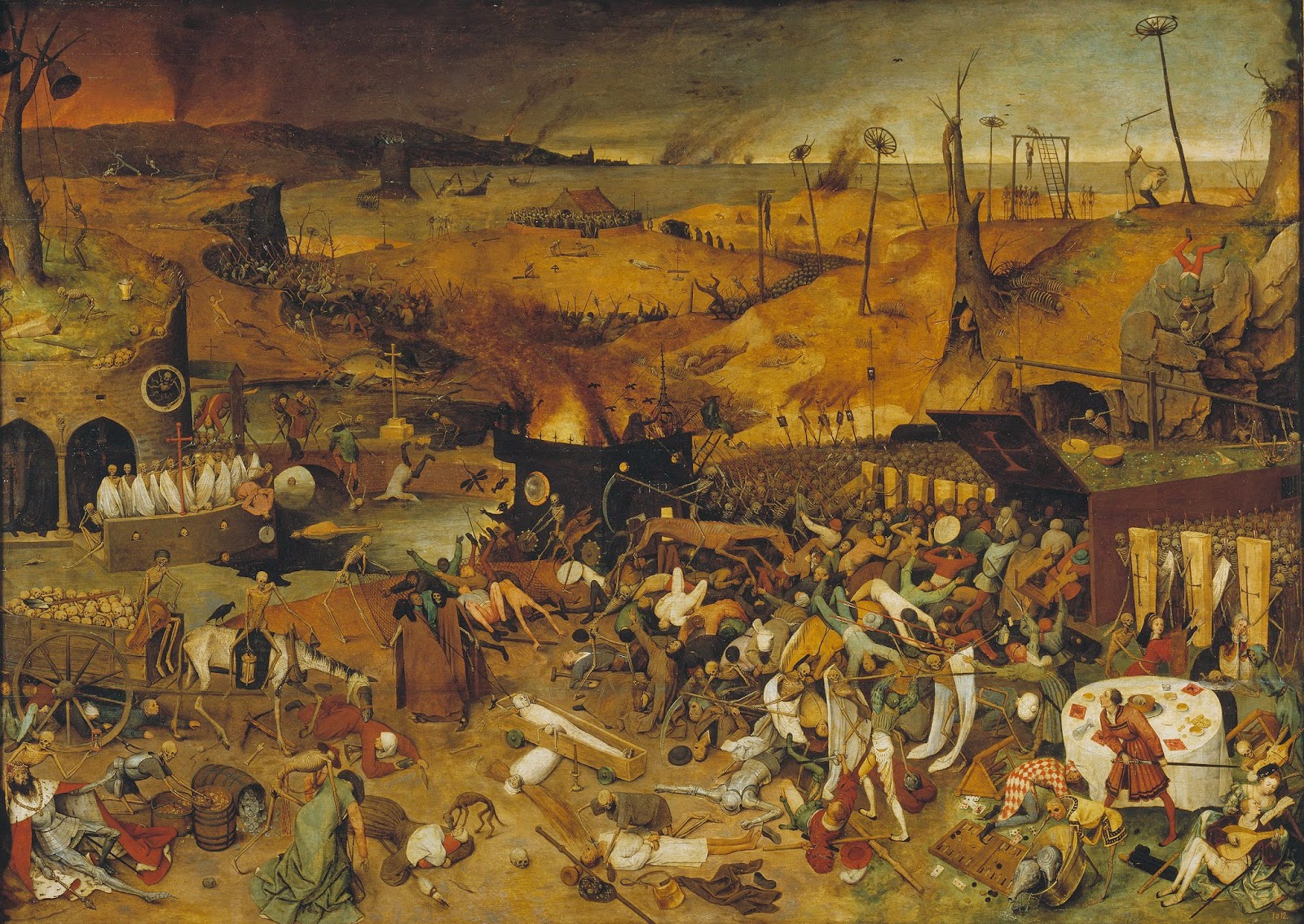
By contrast, Noah and his family are an indistinct crowd slogging through a cloud of dust to board the ark for what is sure to be one long, miserable hiatus from the world. Their wretchedness, their suffering, puts me in mind of the dying masses who reap death as the deserts of sin in Pieter Bruegel the Elder’s painting The Triumph of Death, as well as of those whose portion the Book of Revelation says is “in the lake that burns with fire and sulfur.” (Revelation 21:8, ESV)


In this light--the light of some freewheeling associations--the heathens in The Eve of the Deluge represent a higher type, those who refuse to grovel in religious terror. For me, the wicked have become the godly while the righteous are now the iniquitous.

How’s that for a neat series of moral inversions?
 

Wednesday, March 19, 2014

The Pre-Raphaelites and the Apostate I Have Become—Human Drama (2)


(continued from "The Lady of Shalott" )

The works of the exhibit “Pre-Raphaelites: Victorian Avant-Garde” were arranged in categories. One sentence in the commentary at the beginning of the religion section jumped out at me:


“To the Pre-Raphaelite Brotherhood, the Bible was a treasure house of human drama in which to seek not theological but literary and poetic meaning.”


This struck me as a refreshing way to read the Bible. I know ways to read the Bible. You can view every jot and tittle as literal truth, absolute and eternal. You can figure the Bible is all true somehow--if not literally, then metaphorically. You can mix and match as suits you. You can roll up your sleeves for the historical-critical method. You can ignore the Old Testament for the New and look for moral instruction: “What would Jesus do?” You can mythologize it. Or demythologize it. Really, you can do as you please, but I get a little weary of all that.

So how about just read it like a story?

I’ll admit, the Bible soured for me when I realized the idea on which it was founded and the assertion it was designed to promote--the existence of God--was a fantasy. Nonetheless, there are some deep characters there, some fine dramatic action, and plenty of literary merit. As the years pass, certain stories from the Bible will come to me, and instead of those stories shining light on my experiences, my experiences shed light on the stories. I think, “Ah, this is the point of the story!”

The Bible can, for all its uselessness as a textbook of facts, provide insight into the human spirit--our emotions, our travails, our moral dilemmas--and do so in a profound way as a work of art. The way Anna Karenina does. Or The Satanic Verses. Or DOA: Dead or Alive. We all get something out of stories even when we know they are fiction.

I suppose it encourages me to think that such eminent artists and thinkers as the Pre-Raphaelites, kindred spirits to a certain extent, could have the clarity of vision and boldness of spirit to approach the Bible this way over a hundred years ago in Christian and Victorian England. It’s an approach that affords a kind of truth, just not the kind that will make me go to church.

I am, after all, an apostate.
 

Monday, July 22, 2013

The Devil May Very Well Have Put Dinosaurs Here


One of my favorite musical comebacks in recent years was made by Alice in Chains, with Black Gives Way to Blue in 2009. I was sufficiently moved to blog about it at the time (on a MySpace page I can no longer access), and my enjoyment of the album has only grown in the years since. Thus, I have been eagerly awaiting a new release, and The Devil Put Dinosaurs Here does not disappoint.

Musically, The Devil Put Dinosaurs Here grinds along to almost 70 minutes in inimitable AIC style: plenty of dissonance, sludgy guitars, thoughtful lyrics and healthy doses of acoustic chill and melancholy. The new AIC never comes screaming and kicking at you the way early releases like Facelift and Dirt did, but the band has mastered a polish that was inchoate before. Much more could be said about that, but it’s the album title I want to focus on.

The first thing I thought when I heard the title The Devil Put Dinosaurs Here was that according to the logic of common Christian apologetics, the Devil might very well have done just that. I’m referring to the cosmological argument for the existence of God, according to which everything is cause and effect, and since the chain could not go back to infinity, there must have been a First Cause, a Prime Mover, that got the whole shebang going.

Theologians have known for some time now that the argument doesn’t bear scrutiny, but that doesn’t stop Christian, Muslim and Jewish apologists from purveying its poor logic anyway. One of the biggest problems is that even if it proved the existence of a First Cause--and it doesn’t by a long shot, for reasons I won’t go into here--it would not tell us anything at all about what that First Cause was like. It wouldn’t tell us that the First Cause was good, still engaging with the world, or did things like send his son to earth to suffer and die for our sins. In other words, the First Cause could just as well be the Devil--and as Creator, put dinosaurs here.

The songwriters more likely had in mind the belief to which some fundamentalist types of Christian subscribe according to which the Devil put dinosaur fossils in the soil in order to deceive people about the true nature of God’s creation. They believe, according to a literalist interpretation of certain passages in the Bible, that God created the Earth less than 10,000 years ago. Since dinosaur fossils date many millions of years back, the Devil, the great Deceiver, must have put them there and made them look older than the Earth really is.

Obviously, not all Christians feel the need for such mental gymnastics to preserve their faith. I would guess that AIC count themselves atheists, but it doesn’t take an atheist to deplore the ignorance, money, hate and fear that come with some religious strains such as those of Westboro Baptist Church, which AIC clearly takes aim at in the song after which the album is named:

“The devil put dinosaurs here
Jesus don’t like a queer
The devil put dinosaurs here
No problem with faith, just fear.”

Okay, they’re just rock-and-roll lyrics, but I’ll take a voice raised for the side of Good anywhere I can find it, and I’ll add mine to it.


Sunday, February 19, 2012

What Christopher Hitchens Understood About Religion but His Critics Persist in Saying He Didn’t


A couple years ago, I took an interest in writer, intellectual and renowned atheist Christopher Hitchens about the time he was touring for the release of his book God Is Not Great: How Religion Poisons Everything. On December 15, 2011, Hitchens died of esophageal cancer, and the world has lost a singular commentator on religion, politics, history and literature.

Hitchens’s death makes it easier for his critics to attack him. An example is “Having Faith: What Both Hitchens and Fundamentalists Don't Get About Religion” by Tim Padgett on Time.com. The piece claims that Hitchens, in his efforts to vilify religion, focused on the actions of religious fanatics and fundamentalists and ignored “the silent majority of Christians who aren't hatemongering zealots but who derive hope and humane inspiration from our beliefs.”

This is a tired defense of religion--one I used to employ myself--that draws a distinction between the conception of a perfect God and his imperfect believers and between the horrible things done in the name of religion and the true message of faith. In other words, sure there are Christians like those from Westboro Baptist Church who picket funerals with signs reading “God Hates Fags”, but there are also little old ladies in the local church’s knitting circle who have never harmed a fly. 

Hitchens showed that this evasion is unsatisfactory. In fact, religion’s problems run throughout its history, involve everyday believers as well as clergy, and extend even to official church doctrine and the very basics of faith that no believer would disavow. The Ten Commandments are revealed as forbidding thought crime (“Thou shalt not covet.”), the New Testament exalts human sacrifice (vicarious redemption--the very core of the Jesus myth), and the clergy at the highest levels condone beliefs such as, to use one of Hitchens’s favorite lines, “AIDS is bad but condoms are worse.”

This last is one of the many reasons Hitchens so strongly disliked Mother Theresa--beatified and under consideration for sainthood. She started AIDS care centers and fed the destitute, but preached against measures, like condoms, that would cut down on AIDS incidence and, indirectly but no less surely, poverty. Giving women control over their rate of reproduction, Hitchens said, is the one thing proven to improve living conditions, but religion removes this solution from the table.

The poison runs deep and wide in religion. It even seems to drive otherwise good people to do horrible things, like mutilate the genitalia of children, or to hold ridiculous or repugnant beliefs. The nice old lady in the knitting circle, while of sterling character in many areas of her life, must, if she is to be a member of her religious community in any meaningful sense, hold some beliefs against her better nature. She may believe, for example, that anyone goes to Hell who is non-Christian, which includes a good percentage of the world’s population and some who have never even heard of Christianity.

Hitchens could go on about this at great length. For Padgett to suggest that Hitchens didn’t “get” that religion is a good barrel of apples into which a few rotten ones have slipped suggests only that Padgett has paid little attention to Hitchens’s statements about religion. Hitchens understood that claim all too well and disagreed. For him, religions are the bad apples that are spoiling the rest.

In the post-Hitchens world, the shrugging off of religion’s crimes as the acts or beliefs of a fringe minority of wackos is inexcusable, for those crimes have been clearly delineated as embedded in religion itself and as perpetrated by its highest proponents. In the post-Hitchens world, however, there is one less voice to continue raising those crimes to scrutiny. As Hitchens himself noted on occasion, the fight of free minds against religious tyranny is one that biological evolution does not win for us--each new generation must fight it anew.